Introduction
Parents often ask, “Should my child learn Phonics or Spell Bee first?” While both programs help children develop strong English language skills, they serve different purposes. Understanding the difference between Spell Bee vs Phonics can help you choose the right learning path based on your child’s age, reading ability, and language development.
In general, Phonics teaches children how to read by understanding letter sounds and blending them into words. Spell Bee, on the other hand, focuses on spelling accuracy, vocabulary development, pronunciation, word meanings, and language confidence. Instead of competing with each other, these two programs complement one another and together create a strong English learning foundation.
What is Phonics?
Phonics is a structured method of teaching children to read and pronounce words by learning the relationship between letters and sounds. It introduces children to individual letter sounds, digraphs, blends, and word families, enabling them to decode unfamiliar words with confidence.
Benefits of Phonics
- Develops early reading skills
- Improves pronunciation
- Strengthens phonemic awareness
- Builds reading fluency
- Increases confidence in reading aloud
- Creates a strong literacy foundation
Best suited for: Early learners, preschoolers, kindergarten children, and students beginning their English learning journey.
What is Spell Bee?
Spell Bee is a language development program that goes beyond spelling words correctly. It helps students improve vocabulary, pronunciation, listening skills, word meanings, grammar awareness, and overall communication skills. Through structured learning and regular practice, children gain confidence in using English both academically and in everyday life.
Benefits of Spell Bee
- Improves spelling accuracy
- Expands vocabulary
- Enhances pronunciation
- Develops listening and language skills
- Improves reading comprehension
- Builds confidence in English communication
- Prepares students for Spell Bee competitions
Best suited for: Students who have basic reading skills and want to strengthen their English vocabulary and spelling.
Which is Better: Spell Bee or Phonics?
There isn’t a single answer because both programs have different objectives.
If your child is just beginning to learn English reading, Phonics is the ideal first step. It helps children understand sounds, decode words, and read independently.
If your child already knows how to read simple words but struggles with spelling, vocabulary, pronunciation, or language confidence, Spell Bee is the better choice.
For the best results, many educators recommend learning Phonics first and then progressing to Spell Bee.
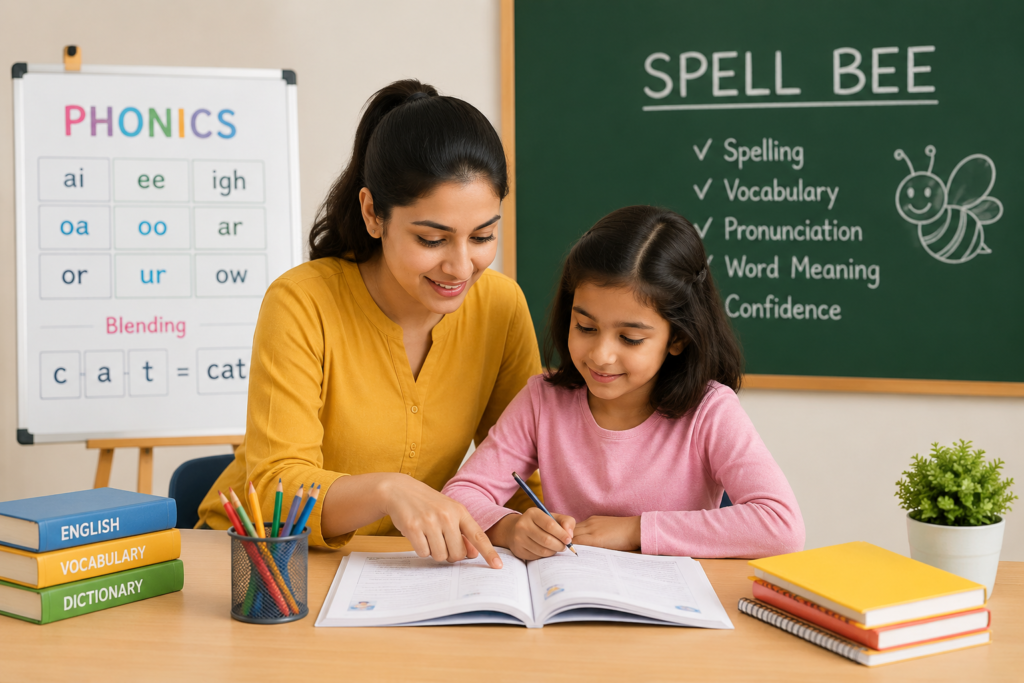
ADA Phonics: Building a Strong Reading Foundation
At Achievers Destination Academy (ADA), the ADA Phonics Program is carefully designed to help young learners develop essential reading skills from the ground up.
The program introduces children to letter sounds, phonemic awareness, blending techniques, decoding strategies, and pronunciation through engaging classroom activities and structured lessons. Instead of memorizing words, children learn how to read unfamiliar words by understanding sound patterns.
Features of ADA Phonics
- Systematic phonics curriculum
- Interactive classroom learning
- Letter sound recognition
- Blending and segmenting practice
- Reading fluency development
- Pronunciation improvement
- Age-appropriate learning materials
- Fun and engaging activities
Benefits of ADA Phonics
- Builds strong reading habits
- Improves pronunciation naturally
- Develops confidence in reading English
- Enhances listening and speaking skills
- Creates a solid foundation for future language learning
ADA Phonics is ideal for children who are beginning their English literacy journey and need a structured approach to reading.
ADA Spell Bee: Strengthening Vocabulary and Language Skills
Once children become comfortable with reading, they can move to the ADA Spell Bee Program, which focuses on expanding their English language abilities.
ADA Spell Bee is much more than learning spellings. It is a comprehensive language enrichment program that helps students improve vocabulary, pronunciation, spelling accuracy, word meanings, listening skills, and communication confidence. The curriculum is designed in progressive levels, allowing students to build their skills step by step.
Features of ADA Spell Bee
- Structured level-based curriculum
- Vocabulary enrichment
- Spelling techniques
- Pronunciation practice
- Listening activities
- Interactive classroom sessions
- Worksheets and assignments
- Mock tests and assessments
- Competition-oriented preparation
- Digital learning support
Benefits of ADA Spell Bee
- Develops an extensive vocabulary
- Improves spelling accuracy
- Enhances pronunciation and communication
- Strengthens reading comprehension
- Increases confidence in English
- Helps students perform better in school
- Prepares children for Spell Bee competitions
The ADA Spell Bee program is suitable for students who want to improve their overall English language proficiency while preparing for academic excellence and language competitions.
Which ADA Program Should Your Child Choose?
Choose ADA Phonics if your child:
- Is new to English reading
- Needs help recognizing letter sounds
- Wants to improve reading fluency
- Is in the early stages of language learning
Choose ADA Spell Bee if your child:
- Can already read basic English words
- Wants to improve spelling accuracy
- Needs a stronger vocabulary
- Wants better pronunciation and communication skills
- Is interested in Spell Bee competitions
For many children, the ideal learning journey begins with ADA Phonics, followed by ADA Spell Bee. This combination helps children first master reading fundamentals and then build advanced vocabulary, spelling, and communication skills for long-term academic success.
Conclusion
When comparing Spell Bee vs Phonics, it is important to remember that these programs are not competitors—they are complementary. Phonics teaches children how to read, while Spell Bee teaches them how to use English effectively through spelling, vocabulary, pronunciation, and communication.
At Achievers Destination Academy (ADA), both programs are designed to support children at different stages of their learning journey. Whether your child is just beginning to read or is ready to enhance vocabulary and spelling skills, ADA provides structured, engaging, and age-appropriate programs that help learners become confident English communicators.
1. What is the difference between Spell Bee and Phonics?
Phonics teaches children how to read by connecting letters with sounds, while Spell Bee focuses on spelling, vocabulary, pronunciation, and overall English language development.
2. Which is Better, Spell Bee or Phonics?
Neither is better than the other. Phonics is ideal for beginners learning to read, while Spell Bee helps children improve spelling, vocabulary, and communication skills after they have basic reading ability.
3. Should my child learn Phonics before Spell Bee?
Yes. Most children benefit from learning Phonics first to build reading skills, then progressing to Spell Bee to strengthen vocabulary and spelling.
4. Can my child learn Phonics and Spell Bee together?
Yes. Learning both programs together can improve reading, spelling, pronunciation, vocabulary, and overall English language skills.