Coding Classes for Kids (Grades 1–8) | Achievers Destination Academy
Coding Classes for Kids – Programming, Logic & Problem-Solving Skills
💻✨ ADA Coding Classes for Kids help children learn programming, logical thinking, problem-solving, and creative technology skills through fun, interactive coding activities. Coding is the new literacy—whatever career a child chooses, understanding how technology works gives them a lasting advantage. 🚀
At Achievers Destination Academy (ADA), children begin with easy drag-and-drop block coding, create their own games, animations, and stories, and gradually progress to real programming languages. Along the way, they learn to break big problems into smaller steps, test ideas, fix mistakes, and keep trying with confidence. Every class ends with something they have created, building pride, creativity, and motivation. 🌟
🎯 Explore Coding Classes Near Me, Programming Classes for Kids, Scratch Coding Classes, Beginner Coding Courses for Children, Online Coding Classes, and Offline Coding Classes to help your child develop coding logic, digital creativity, and future-ready skills.
Start Free Mock Test Now
What Are Coding Classes for Kids?
More Than Coding – A Complete Future-Ready Learning Journey
- Logical thinking: Children learn to plan, sequence and reason step by step.
- Problem solving: Breaking down problems and debugging builds persistence.
- Creativity: Games, animations and stories come from the child’s own imagination.
- Better maths and science: Coding strengthens patterns, logic and numerical thinking.
- Screen time with purpose: Creating instead of passively consuming.
- Confidence: Seeing their own project work builds self-belief.
- Future readiness: Technology skills are valuable in nearly every career.
- Teamwork and communication: Group projects and demo sessions build collaboration.
Course Structure
Foundation skills (early grades)
- Sequencing, patterns and step-by-step instructions
- Block coding: loops, events and motion
- Creating animations, stories and simple games
- Basic debugging: finding and fixing mistakes
Intermediate skills (middle grades)
- Variables, conditions and operators
- Designing interactive games with scores, levels and characters
- Functions and reusable code
- Transition from blocks to typed code
Advanced skills (upper grades)
- Python programming: data types, loops, lists and functions
- Web basics: building simple web pages with HTML and CSS
- Logic building and algorithmic thinking
- Planning, building and presenting a complete project
- Introduction to AI and how everyday technology works
Watch Our Students in Action
Voices of Our Achievers
Why Our Coding Classes are the Preferred Choice for Parents?
- Logical thinking: Children learn to plan, sequence and reason step by step.
- Problem solving: Breaking down problems and debugging builds persistence.
- Creativity: Games, animations and stories come from the child’s own imagination.
- Better maths and science: Coding strengthens patterns, logic and numerical thinking.
- Screen time with purpose: Creating instead of passively consuming.
- Confidence: Seeing their own project work builds self-belief.
- Future readiness: Technology skills are valuable in nearly every career.
- Teamwork and communication: Group projects and demo sessions build collaboration.
Step-by-Step Learning Process
- Learn by making: Every concept is taught through a hands-on project, not theory alone.
- Unplugged first: Younger children learn logic through games and activities before touching a computer.
- Step by step: Small, achievable challenges build confidence at each stage.
- Debug without fear: Mistakes are treated as puzzles to solve, building resilience.
- Creative freedom: After guided projects, children design their own games and stories.
- Show and share: Every child presents their work, building communication and pride.
Benefits for Parents!
- Screen time that builds skills instead of just entertainment
- Visible projects you can see, play and share
- A child who is more logical, focused and confident
- Better performance in maths and problem solving at school
- Structured, safe learning guided by trained teachers
Why Choose ADA?
- Trained teachers following a standardised ADA curriculum
- Project-first learning: children create something in every module
- Clear grade-wise path from first block to real programming
- Small batches for individual attention
- Complete enrichment ecosystem: Coding works alongside ADA’s Mental Maths, Public Speaking, Abacus and Spell Bee programs [links: /mental-maths, /public-speaking, /abacus, /spell-bee]
- Safe digital environment with age-appropriate tools and supervised use
- Proven brand: ADA, a Vaisn Educational Services LLP initiative, with [X] centres across [locations]
Who Can Join Our Coding Classes?
- Children aged 6–14 years
- Students from Grade 1 to Grade 8
- Beginners curious about coding, games, and technology
- Kids who enjoy creating stories, animations, games, or digital projects
- Students who want to build logical thinking, problem-solving, and future-ready skills
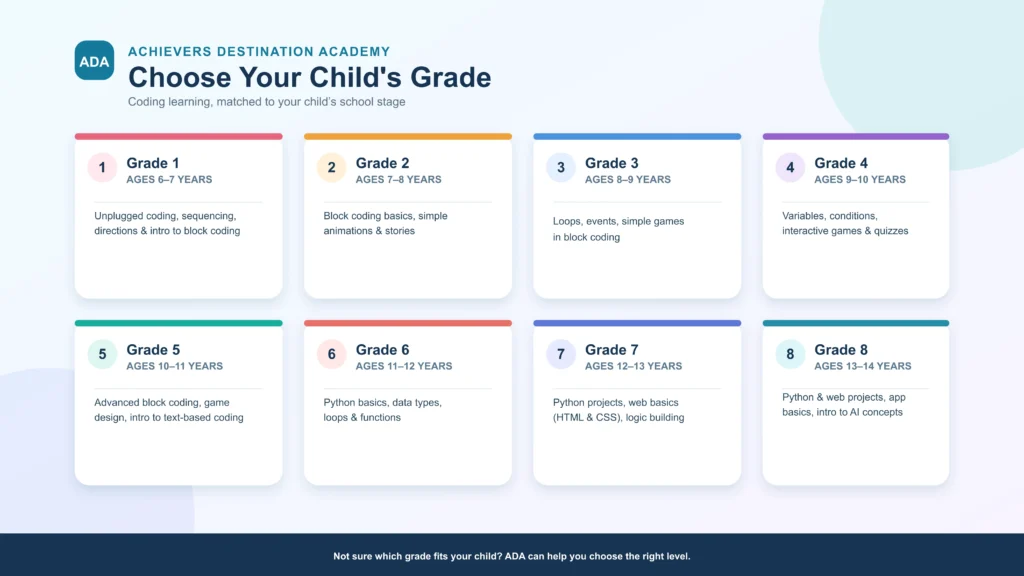
Choose Your Child’s Grade – Coding Classes
Every child learns at a different pace. Our grade-wise Coding curriculum helps students build logical thinking, creativity, and programming skills at the right level.
- Grade 1 (Ages 6–7): Unplugged coding, sequencing, directions, and introduction to block coding
- Grade 2 (Ages 7–8): Block coding basics, simple animations, and stories
- Grade 3 (Ages 8–9): Loops, events, and simple games in block coding
- Grade 4 (Ages 9–10): Variables, conditions, interactive games, and quizzes
- Grade 5 (Ages 10–11): Advanced block coding, game design, and introduction to text-based coding
- Grade 6 (Ages 11–12): Python basics, data types, loops, and functions
- Grade 7 (Ages 12–13): Python projects, web basics with HTML and CSS, and logic building
- Grade 8 (Ages 13–14): Python and web projects, app basics, and introduction to AI concepts
Not sure which grade is right for your child? Book a free demo with ADA, and our teacher will guide you to the suitable level.
🌍 Join ADA Coding Classes from Anywhere in the World!
🧮✨ Learn Coding with ADA, Wherever You Are! Achievers Destination Academy welcomes students from across the globe to join our engaging abacus training programs. 🚀 Whether you prefer online learning or offline classes at a nearby center, children can develop calculation speed, concentration, memory, and confidence with ADA.
🌎 We Welcome Students from: India 🇮🇳 | UAE 🇦🇪 | USA 🇺🇸 | UK 🇬🇧 | Canada 🇨🇦 | Australia 🇦🇺 | Singapore 🇸🇬 | Malaysia 🇲🇾 | Saudi Arabia 🇸🇦 | Qatar 🇶🇦 | Srilanka 🇱🇰 | Kuwait 🇰🇼 and many more countries worldwide! 🌟
🌟 Explore Our Other Courses
🌟📚 Explore Our Other Courses! 🧮✨ Discover exciting learning opportunities with ADA, including Abacus, Vedic Maths, Spell Bee, Phonics, Handwriting, Mental Maths, Public Speaking , AI, French, Chess, Maths Olympiad, Online Classes for Kids, JEE Foundation, NEET Foundation, and SAT Classes. 🚀🌍 Learn New Skills, Unlock Potential, and Grow with ADA! 🎯💡
Frequently Asked Questions (FAQs)
Phonics classes teach children the relationship between letters and their sounds, helping them recognise words, blend sounds, and develop early reading skills. Through structured activities and practice, children can improve word recognition, pronunciation, spelling, and reading confidence.
Many children can begin phonics around 3–6 years of age, depending on their development and readiness. Early learners may start by recognising letters and sounds, while older beginners can work on blending sounds and reading words. The right starting level depends on the child.
Phonics classes help children recognise letter sounds, blend sounds into words, improve decoding skills, and develop early spelling and reading abilities. Regular, age-appropriate practice can also support pronunciation, vocabulary development, and confidence when reading aloud.
Yes, online phonics classes can be effective when they include live interaction, sound-based activities, guided reading, and regular practice. Parents should look for an experienced trainer, engaging lessons, individual feedback, and activities that children can practise at home.
Both online and offline phonics classes can help children develop reading skills. Online classes offer flexibility and learning from home, while offline classes provide face-to-face interaction and hands-on activities. Parents should choose based on their child’s attention span, learning preferences, schedule, and available support.
Phonics classes help children learn how to connect letters with sounds and decode unfamiliar words. With continued practice in phonics, vocabulary, and reading comprehension, children can gradually develop reading fluency. Progress varies according to their starting level, practice, and learning needs.
Phonics class fees vary depending on the institute, course duration, number of sessions, trainer support, and online or offline format. Parents should ask about admission fees, course materials, assessment charges, and any additional costs before enrolling their child.
The learning period depends on the child’s age, familiarity with letters, lesson frequency, and regular practice. Children may learn basic letter sounds first, then progress to blending, reading words, and more complex sound patterns. Parents should ask the institute about its syllabus and learning milestones.
Yes, many beginner phonics programmes accept children who are still learning the alphabet. Lessons can introduce letter recognition and sounds gradually before moving on to blending and reading simple words. Parents should confirm that the course supports complete beginners.
Phonics teaches children how letters and letter combinations represent sounds in words. This knowledge can help them pronounce unfamiliar words, identify sound patterns, and spell words more accurately. Regular listening, speaking, reading, and writing activities help reinforce these skills.
A beginner phonics course typically covers letter sounds, sound recognition, blending, segmenting, simple word reading, and early spelling. As children progress, they may learn digraphs, long and short vowel sounds, and more complex spelling patterns. The exact syllabus varies by programme.
Yes, age-appropriate phonics activities can help nursery, LKG, and UKG children develop early literacy skills. Younger learners may focus on listening, letter sounds, and sound recognition, while more advanced learners practise blending sounds and reading simple words.
Compare phonics programmes based on trainer experience, teaching methods, course structure, class size, fees, and parent feedback. Check whether online classes or an offline centre are available in your area. A demo class can help you understand whether the teaching style suits your child.
Yes, online phonics classes can allow children to learn from home, depending on the institute’s programme and schedule. Before enrolling, check age eligibility, live class timings, trainer interaction, learning materials, and the amount of reading practice provided between sessions.
Parents interested in phonics classes at Achievers Destination Academy (ADA) can contact the team to enquire about online and offline learning options, course levels, fees, and available batches. Share your child’s age and preferred learning format so the team can guide you through the enrolment process.
Build your child’s foundation in letter sounds, word recognition, pronunciation, and early reading with Phonics Classes at Achievers Destination Academy (ADA).
Explore our online and offline phonics learning options and contact our team to learn about course details, fees, and available batches.
Copy WhatsApp Enquiry Message