AI Classes for Kids (Grades 1–8) | Achievers Destination Academy
AI Classes for Kids – Artificial Intelligence, Coding & Future-Ready Skills
🤖✨ ADA AI Classes for Kids introduce children to Artificial Intelligence through fun, age-appropriate, hands-on learning. Children explore what AI is, how machines learn from data, how to write clear prompts for AI tools, and how to think critically about AI-generated results. 🚀
At Achievers Destination Academy (ADA), our Artificial Intelligence classes for children go beyond using technology. Students create simple AI-based projects while learning the importance of safe, honest, and responsible AI use. These engaging sessions build creativity, logical thinking, digital confidence, and future-ready skills. 🌟
🎯 Explore AI Classes Near Me, Artificial Intelligence Courses for Kids, AI and Coding Classes, Machine Learning for Kids, AI Training for Students, Online AI Classes, Offline AI Classes, Prompt Engineering for Kids, and Future Skills Classes to help your child understand, create with, and use AI confidently and responsibly.
Start Free Mock Test Now
What are AI Classes?
More Than AI – A Complete Future-Ready Learning Journey
ADA’s AI program teaches children how AI works, how to use it wisely and how to build with it, through fun, hands-on projects and guided, safe learning from Grade 1 to Grade 8.
- Hands-on AI projects, no prior experience needed
- Learn to use AI smartly, safely and responsibly
- Builds thinking skills, not dependence on tools
- Free demo class for every child
Course Structure
Foundation skills (early grades)
- What AI is and where it appears in daily life
- Difference between human thinking and machine thinking
- Patterns, sorting and simple decision-making
- Safe and respectful use of technology
Intermediate skills (middle grades)
- How machines learn from data and examples
- Training simple models to recognise images, sounds or gestures
- Giving clear, step-by-step instructions to AI tools
- Checking AI answers for accuracy
Advanced skills (upper grades)
- Building AI-powered projects such as classifiers and simple chatbots
- Understanding bias, fairness and why AI can be wrong
- Data privacy, deepfakes and online safety
- Using AI as a learning and creative partner, without copying
Watch Our Students in Action
Voices of Our Achievers
Why Our AI Classes are the Preferred Choice for Parents?
- Future readiness: AI is changing nearly every career. Early understanding is a lasting advantage.
- Critical thinking: Children learn to question, verify and not blindly trust what AI says.
- Smart use, not misuse: They learn to use AI to learn and create, not to copy or shortcut.
- Problem solving: Training a simple AI model teaches logic, data and testing.
- Creativity: Using AI as a tool to design stories, art, music and ideas.
- Digital safety: Awareness of privacy, fake content and online risks.
- Confidence with technology: Children become creators and thinkers, not just users.
- Strong foundations: Builds on logic and maths skills that school subjects rely on.
Our Learning Approach
- Understand before using: Children learn how AI works before relying on it.
- Learn by building: Every concept is taught through a hands-on activity or project.
- Screen-light for young learners: Early grades use unplugged games and role-play.
- Think first, then ask AI: Children attempt problems themselves before using tools.
- Question everything: Children are trained to verify AI outputs and spot mistakes.
- Safety built in: Supervised, age-appropriate tools only, with clear rules on privacy and responsible use.
Projects Your Child Will Build 🚀
Early grades
- “Be the robot”: instruction-following games
- Sort-the-objects pattern game
- Smart-machine picture book
Middle grades
- Image classifier: teach a computer to tell apart fruits, animals or objects
- Sound or gesture recogniser
- Clear-instruction challenge: get the best result from an AI tool
Upper grades
- Simple chatbot for a school or hobby topic
- AI-powered story, art or quiz project
- Bias-spotting investigation
- Capstone AI project presented at demo day
Benefits of AI Training for Kids
- Builds Future-Ready Skills: Children understand the technology shaping education, work, and daily life.
- Improves Logical Thinking: AI activities teach children to identify patterns, analyse information, and solve problems step by step.
- Boosts Creativity: Kids use AI tools to explore ideas and build stories, projects, and digital solutions.
- Develops Digital Confidence: Children become comfortable using technology with curiosity and purpose.
- Teaches Responsible Technology Use: Students learn about AI safety, privacy, bias, honesty, and responsible decision-making.
- Strengthens Communication: Learning to give clear prompts helps children organise thoughts and explain ideas effectively.
- Encourages Innovation: AI classes inspire children to think beyond consuming technology and start creating with it.
Who Can Join Our AI Classes?
- Children aged 6–14 years
- Students from Grade 1 to Grade 8
- Beginners curious about Artificial Intelligence and technology
- Kids who enjoy creating projects, solving problems, and exploring new ideas
- Students who want to build logical thinking, creativity, and responsible AI skills
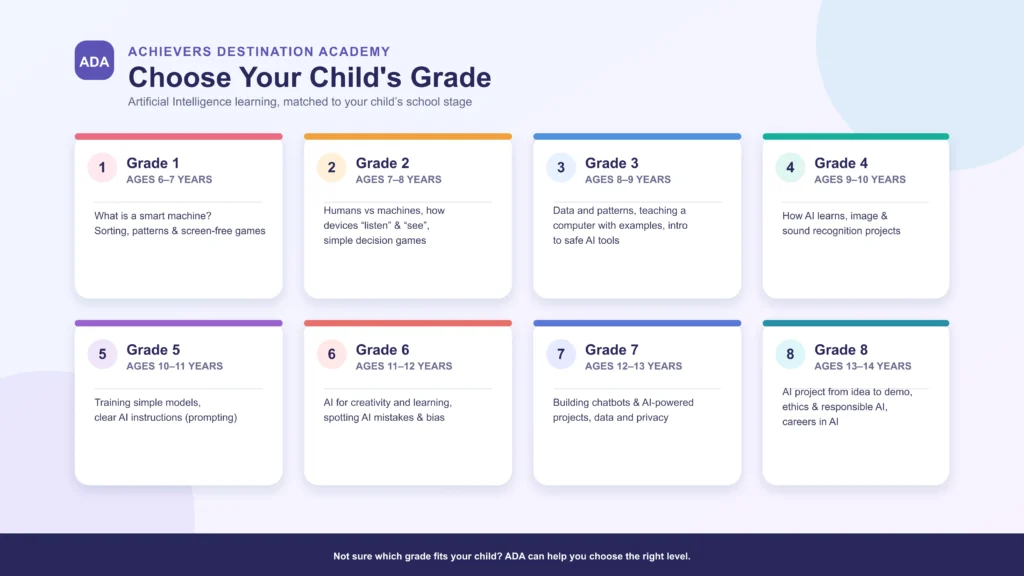
Choose Your Child’s Grade – AI Classes
Every child learns technology at a different pace. Our grade-wise AI curriculum helps students understand Artificial Intelligence, build creative projects, and develop responsible future-ready skills at the right level.
- Grade 1 (Ages 6–7): Smart machines, sorting, patterns, and screen-free AI games
- Grade 2 (Ages 7–8): Humans vs machines, how devices listen and see, and simple decision games
- Grade 3 (Ages 8–9): Data, patterns, teaching computers with examples, and safe AI tools
- Grade 4 (Ages 9–10): How AI learns, image recognition, and sound recognition projects
- Grade 5 (Ages 10–11): Training simple models and giving clear instructions to AI tools
- Grade 6 (Ages 11–12): AI for creativity and learning, spotting AI mistakes and bias
- Grade 7 (Ages 12–13): Building chatbots, AI-powered projects, data, and privacy
- Grade 8 (Ages 13–14): AI projects from idea to demo, ethics, responsible AI, and careers in AI
Not sure which grade is right for your child? Book a free demo with ADA, and our teacher will guide you to the suitable level.
🌍 Join ADA AI Classes from Anywhere in the World!
🧮✨ Learn AI with ADA, Wherever You Are! Achievers Destination Academy welcomes students from across the globe to join our engaging abacus training programs. 🚀 Whether you prefer online learning or offline classes at a nearby center, children can develop calculation speed, concentration, memory, and confidence with ADA.
🌎 We Welcome Students from: India 🇮🇳 | UAE 🇦🇪 | USA 🇺🇸 | UK 🇬🇧 | Canada 🇨🇦 | Australia 🇦🇺 | Singapore 🇸🇬 | Malaysia 🇲🇾 | Saudi Arabia 🇸🇦 | Qatar 🇶🇦 | Srilanka 🇱🇰 | Kuwait 🇰🇼 and many more countries worldwide! 🌟
🌟 Explore Our Other Courses
🌟📚 Explore Our Other Courses! 🧮✨ Discover exciting learning opportunities with ADA, including Abacus, Vedic Maths, Spell Bee, Handwriting, Mental Maths, Public Speaking, Coding, French, Chess, Maths Olympiad, Online Classes for Kids, JEE Foundation, NEET Foundation, and SAT Classes. 🚀🌍 Learn New Skills, Unlock Potential, and Grow with ADA! 🎯💡
Frequently Asked Questions (FAQs)
Phonics classes teach children the relationship between letters and their sounds, helping them recognise words, blend sounds, and develop early reading skills. Through structured activities and practice, children can improve word recognition, pronunciation, spelling, and reading confidence.
Many children can begin phonics around 3–6 years of age, depending on their development and readiness. Early learners may start by recognising letters and sounds, while older beginners can work on blending sounds and reading words. The right starting level depends on the child.
Phonics classes help children recognise letter sounds, blend sounds into words, improve decoding skills, and develop early spelling and reading abilities. Regular, age-appropriate practice can also support pronunciation, vocabulary development, and confidence when reading aloud.
Yes, online phonics classes can be effective when they include live interaction, sound-based activities, guided reading, and regular practice. Parents should look for an experienced trainer, engaging lessons, individual feedback, and activities that children can practise at home.
Both online and offline phonics classes can help children develop reading skills. Online classes offer flexibility and learning from home, while offline classes provide face-to-face interaction and hands-on activities. Parents should choose based on their child’s attention span, learning preferences, schedule, and available support.
Phonics classes help children learn how to connect letters with sounds and decode unfamiliar words. With continued practice in phonics, vocabulary, and reading comprehension, children can gradually develop reading fluency. Progress varies according to their starting level, practice, and learning needs.
Phonics class fees vary depending on the institute, course duration, number of sessions, trainer support, and online or offline format. Parents should ask about admission fees, course materials, assessment charges, and any additional costs before enrolling their child.
The learning period depends on the child’s age, familiarity with letters, lesson frequency, and regular practice. Children may learn basic letter sounds first, then progress to blending, reading words, and more complex sound patterns. Parents should ask the institute about its syllabus and learning milestones.
Yes, many beginner phonics programmes accept children who are still learning the alphabet. Lessons can introduce letter recognition and sounds gradually before moving on to blending and reading simple words. Parents should confirm that the course supports complete beginners.
Phonics teaches children how letters and letter combinations represent sounds in words. This knowledge can help them pronounce unfamiliar words, identify sound patterns, and spell words more accurately. Regular listening, speaking, reading, and writing activities help reinforce these skills.
A beginner phonics course typically covers letter sounds, sound recognition, blending, segmenting, simple word reading, and early spelling. As children progress, they may learn digraphs, long and short vowel sounds, and more complex spelling patterns. The exact syllabus varies by programme.
Yes, age-appropriate phonics activities can help nursery, LKG, and UKG children develop early literacy skills. Younger learners may focus on listening, letter sounds, and sound recognition, while more advanced learners practise blending sounds and reading simple words.
Compare phonics programmes based on trainer experience, teaching methods, course structure, class size, fees, and parent feedback. Check whether online classes or an offline centre are available in your area. A demo class can help you understand whether the teaching style suits your child.
Yes, online phonics classes can allow children to learn from home, depending on the institute’s programme and schedule. Before enrolling, check age eligibility, live class timings, trainer interaction, learning materials, and the amount of reading practice provided between sessions.
Parents interested in phonics classes at Achievers Destination Academy (ADA) can contact the team to enquire about online and offline learning options, course levels, fees, and available batches. Share your child’s age and preferred learning format so the team can guide you through the enrolment process.
Build your child’s foundation in letter sounds, word recognition, pronunciation, and early reading with Phonics Classes at Achievers Destination Academy (ADA).
Explore our online and offline phonics learning options and contact our team to learn about course details, fees, and available batches.
Copy WhatsApp Enquiry Message