

ADA 10X Growth Card
A New Way to Understand, Measure and Improve Learning
Education should be about more than completing a syllabus—it should show how a child is progressing, which skills are improving, and where the right support is needed next.
Introducing the ADA 10X Card: a structured student-progress system that helps parents, teachers, and educational institutions track assessments, compare performance, and make learning growth more visible.
Give your child a clearer path to progress. Connect with ADA today to learn how the ADA 10X Card can support better learning decisions.

THE REALITY OF TODAY'S EDUCATION SYSTEM
Is Your Child Learning—or Simply Completing a Course?
Children attend classes, complete worksheets, take assessments, and move to the next level. But course completion alone does not always show whether a child has truly mastered the skills they need.
Parents often want clear answers: Has my child improved in speed, accuracy, concentration, confidence, or understanding? Which skills are strong, and where is extra support needed?
The ADA 10X Card helps make a child’s learning progress visible. It uses structured assessments to record the starting level, compare performance over time, and identify the next steps for better learning.
WHAT IS THE ADA 10X CARD?
A Structured Record of the Student’s Learning Journey
The ADA 10X Card is a student progress-tracking tool that records selected performance indicators before and after a learning level.
It connects assessment, learning, practice and progress review in a structured process.
The 10X Card helps record and compare:
- The student’s initial skills and performance.
- Assessment results at the starting point.
- Completion time, where relevant to the course and assessment.
- The student’s performance after completing the learning level.
- Changes in skills, time and assessment results.
- Areas where further practice may be beneficial.
The results provide a clearer picture of the student’s learning journey and support discussions between teachers and parents.
WHY DID ADA INTRODUCE THE 10X CARD?
ADA 10X Card: From Course Completion to Measurable Learning Progress
The ADA 10X Card is a structured student progress-tracking system designed to help parents, teachers, and educational centres understand a child’s learning journey more clearly.
The process is simple: identify the student’s starting level through a pre-assessment, support learning through guided practice, assess performance again, and compare the results. This gives everyone a clearer picture of what the student has learned, where they have improved, and what support may be needed next.
Why the ADA 10X Card matters?
Clear starting benchmark: A pre-assessment identifies what a student already knows before learning begins.
Visible learning improvement: Before-and-after assessments help show changes in skills, speed, accuracy, understanding, and confidence.
Better parent involvement: Parents can understand their child’s starting performance and review progress through structured student progress reports.
Focused teaching support: Teachers can identify strengths, learning gaps, and areas that need additional practice.
Consistent progress tracking: A clear assessment process makes it easier for centres and teachers to record results and communicate progress consistently.
The ADA 10X Card shifts the conversation from only asking, “Has the course been completed?” to asking, “What has the student learned, how has performance improved, and what should happen next?”
WHAT DOES "10X" MEAN?
A Commitment to Thinking Beyond Course Completion
The ADA 10X Card represents a progress-focused approach to learning: establish a baseline, work towards improvement, measure the change and identify the next goal.
It should not be interpreted as a guarantee that every student will improve tenfold. Student outcomes depend on individual starting levels, learning needs, practice, teaching support and assessment results.
Instead, the 10X philosophy encourages educators to think beyond completing lessons and to focus on the quality and visibility of learning progress.
Set a benchmark. Work towards improvement. Measure what changes. Keep growing.
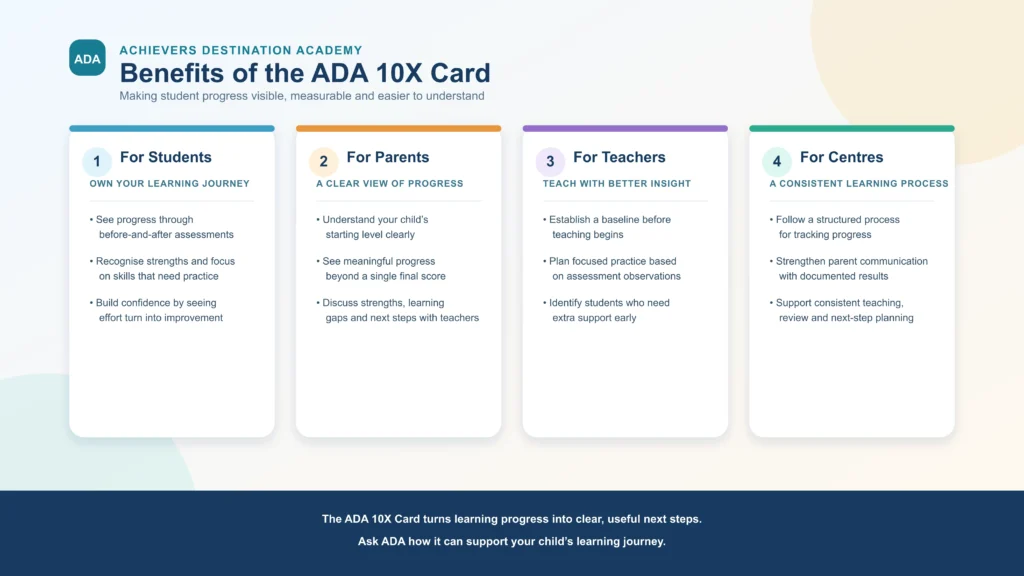
How the ADA 10X Card supports students and parents?
Tracks real skill improvement: See progress beyond marks and course completion.
Shows before-and-after performance: Compare starting assessments with later results clearly.
Identifies learning gaps early: Recognise areas that need additional practice and support.
Gives parents clearer updates: Understand your child’s progress through structured student progress reports.
Helps teachers plan better support: Assessment insights help teachers focus on the skills that matter most.
How Does the ADA 10X Card Work?
A Simple, Structured Progress-Tracking Process
Step 1 — Pre-Assessment
Before the learning level begins, the student completes an assessment in the presence of a parent. The teacher records the student’s skills, performance, and completion time on the ADA 10X Card.
This creates a clear starting benchmark.
Step 2 — Learning & Practice
The student follows the relevant ADA learning programme with teacher guidance, curriculum materials, worksheets, practice resources, and additional support where needed.
The focus is on building skills and improving performance.
Step 3 — Post-Assessment
After completing the learning level, the student takes a post-assessment. The teacher records skills, performance, and completion time again.
This shows the student’s progress after learning and practice.
Step 4 — Compare Progress
The teacher compares the pre-assessment and post-assessment to review improvements in:
Skills demonstrated
Accuracy and performance
Completion time, where measured
Step 5 — Record Growth & Plan Next Steps
The student’s progress is recorded in the Growth section of the ADA 10X Card. Parents and teachers can then review strengths, identify areas needing more support, and set the next learning goal.
Pre-Assessment → Learn & Practise → Post-Assessment → Compare → Record Growth
How Can the ADA 10X Card Support Better Learning?
The ADA 10X Card helps shift the focus from simply completing a course to understanding a student’s actual learning progress.
From course completion to skill growth: Track what a student has learned and improved.
From general feedback to clear evidence: Use before-and-after assessments to make progress visible.
From one practice plan to targeted support: Identify learning gaps and focus on the skills that need more attention.
From parent uncertainty to informed involvement: Help parents understand their child’s progress and next learning goals.
The ADA 10X Card gives parents, teachers, and learning centres a clearer way to track student progress and support better outcomes.
Want to make learning progress more visible? Connect with ADA to learn more about the 10X Card.
WATCH THE ADA 10X CARD EXPLAINER VIDEO
Who Can Explore the ADA 10X Card?
Parents
Understand how structured assessments and progress reviews can support your child’s learning journey.
Teachers
Discover how to record student performance, identify learning gaps and use assessment findings to support improvement.
Schools and Educational Institutions
Explore how a structured student progress-tracking process could complement your teaching and parent-engagement practices.
Education Entrepreneurs and Franchise Enquirers
Learn about ADA’s educational programmes, operating processes and opportunities to explore working with ADA.
Frequently Asked Questions (FAQs)
The ADA 10X Card is a structured student progress-tracking tool used to record and compare selected assessment results before and after a learning level. It helps teachers and parents understand a student’s observed progress, identify strengths, and recognise areas that may need further practice.
The ADA 10X Card records relevant assessment findings before and after learning. Comparing these results helps teachers and parents review changes in performance, understand the child’s learning progress, and make informed decisions about further practice.
A student progress-tracking card gives parents a clearer view of their child’s performance in selected skills. It supports discussions with teachers, helps identify learning gaps, and provides a structured record of assessment results instead of relying only on general impressions.
The process involves a pre-assessment, a period of learning and practice, and a post-assessment. The teacher compares the results and records the relevant findings on the ADA 10X Card to document the student’s observed progress.
The ADA 10X Card process is designed to support transparency by having parents present during assessments, where applicable. This allows parents to observe the process and discuss the results with the teacher for a better understanding of their child’s performance.
The card records relevant skills, completion time where applicable, and assessment findings required by the process. These details help teachers compare performance across assessments and identify areas where additional practice may be beneficial.
The ADA 10X Card can help teachers identify students’ strengths, recognise learning gaps, review changes between assessments, and plan targeted practice. It provides a structured reference for discussing progress and deciding what learning support may be needed next.
No. The name 10X Card does not guarantee tenfold improvement or a particular learning outcome. It is a progress-tracking tool that records observed assessment results. A student’s progress depends on factors such as their starting level, practice, learning needs, and consistency.
The ADA 10X Card is not a replacement for regular examinations. It complements existing assessment methods by providing a structured way to compare selected skills before and after learning, helping parents and teachers understand progress beyond an individual test result.
Parents can review assessment findings with the teacher, compare pre-assessment and post-assessment results, and discuss the skills that have improved or still need practice. The ADA 10X Card can support these conversations with recorded information about the student’s performance.
Schools and educational institutes can enquire about ADA’s student progress-tracking approach and explore whether it suits their educational programmes. Implementation requirements, assessment procedures, and the intended use should be discussed with the ADA team.
Teachers can use a consistent assessment process, record baseline performance, provide structured learning and practice, and conduct a comparable follow-up assessment. The ADA 10X Card supports this approach by documenting relevant findings for comparison.
Yes. The card can provide a structured starting point for parent-teacher discussions by showing recorded assessment findings and observed changes in performance. Teachers and parents can use the information to discuss strengths, learning needs, and possible next steps.
Parents, teachers, school administrators, and educational institute owners can contact Achievers Destination Academy (ADA) to learn about the purpose of the 10X Card, how the assessment process works, and whether it is suitable for their learning environment.
Schools and institutes interested in structured student progress tracking can contact Achievers Destination Academy to discuss the 10X Card process, assessment recording, parent involvement, and implementation requirements. Share your institution type and intended use so the ADA team can guide your enquiry.