Chess Classes for Kids, Teenagers and Adults | Achievers Destination Academy
Chess Classes for Kids, Teenagers & Adults – Strategy, Focus & Critical Thinking Skills
♟️✨ ADA Chess Classes help children, teenagers, and adults build strategic thinking, concentration, problem-solving, and decision-making skills through engaging chess training. 🚀 Enrol in Chess Classes with Achievers Destination Academy (ADA) to learn chess basics, tactics, openings, middle-game strategies, and endgame techniques with confidence.
🎯 Explore Chess Classes Near Me, Chess Coaching for Kids, Chess Classes for Teenagers, Chess Training for Adults, Beginner Chess Classes, Online Chess Classes, Offline Chess Classes, and Chess Tournament Preparation to improve focus, sharpen strategy, and enjoy the game at every level! 🌟🏆
Start Free Mock Test Now
What Are Chess Classes?
More Than Chess – A Complete Strategy & Thinking Development Journey
- Level-Based Learning: Beginner, intermediate, and advanced chess training designed for children, teenagers, and adults.
- Strong Foundation: Builds understanding of chessboard setup, piece movements, rules, notation, and basic openings.
- Practice-Based Learning: Regular puzzles, tactical exercises, guided games, and analysis sessions make learning engaging.
- Strategic Thinking: Players learn opening principles, middle-game planning, endgame techniques, and decision-making.
- Skill Development: Improves concentration, patience, memory, problem-solving, and critical thinking.
- Progress-Oriented Training: Helps learners build confidence for friendly games, competitive play, and tournament preparation.
Course Structure
What You Will Learn?
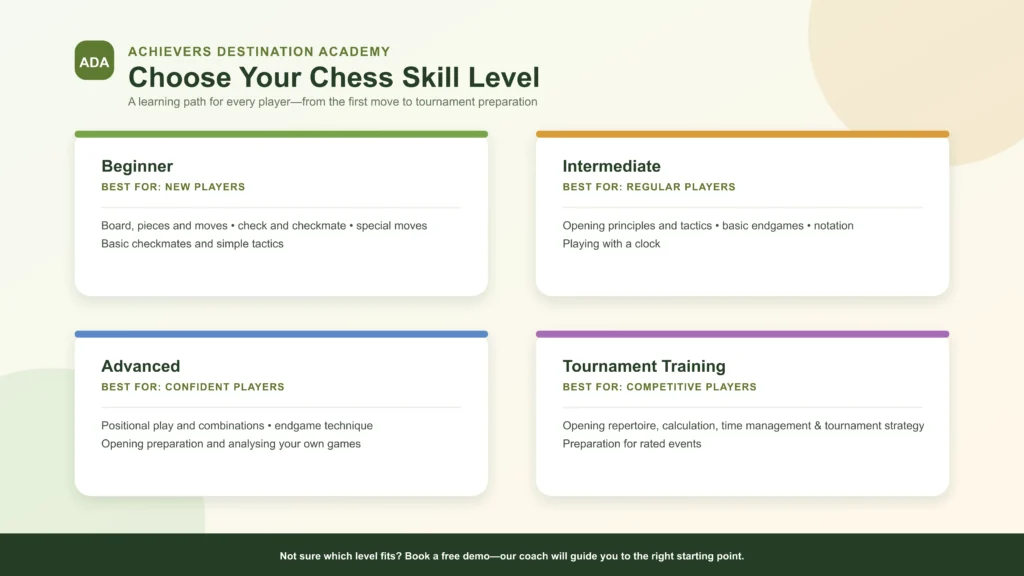
Beginner
- The board, pieces, their moves and values
- Check, checkmate, stalemate and special moves (castling, en passant, promotion)
- Basic checkmates and simple tactics
- Good habits: touch-move rule, sportsmanship, writing moves
Intermediate
- Opening principles and a first opening repertoire
- Tactics: forks, pins, skewers, discovered attacks and more
- Basic endgames and how to convert an advantage
- Reading and writing chess notation
- Playing with a chess clock
Advanced and Tournament Training
- Positional play, pawn structure and long-term planning
- Combinations and calculation of variations
- Endgame technique and opening preparation
- Analysing your own games and learning from mistakes
- Tournament strategy, time management and handling pressure
Watch Our Students in Action
Voices of Our Achievers
Why Our Chess Classes are the Preferred Choice for Parents?
- Trained chess coaches following a standardised ADA curriculum [confirm coach qualifications and any rated or titled coaches]
- Separate batches for kids, teenagers and adults, so everyone learns comfortably
- Level-matched play so every learner gets the right challenge
- Real tournament exposure from friendly games to competitions
- Small batches for individual attention
Our Learning Approach
- Learn by playing: Every concept is practised in a real game, not just explained.
- Step by step: Rules, then tactics, then strategy, so no one feels lost.
- Puzzles regularly: Short tactical puzzles build pattern recognition.
- Coach demonstrations: Live demonstrations on a demo board keep classes interactive.
- Analyse and improve: Learners review their games and learn from mistakes without fear.
- Play against equals: Practice games are matched by playing level for fair, motivating challenges.
- Compete and celebrate: Tournaments and certificates give everyone something to work towards.
Benefits of Chess Training for Kids
- A child who concentrates longer and thinks before acting
- Better handling of pressure, wins and losses
- Screen-free, healthy mental challenge
- Clear levels, visible progress and a safe, friendly environment with trained coaches
- A new skill, learned at your own pace with no pressure
- A mentally stimulating break from screens and routine
Who Can Join Our Chess Classes?
- Learners aged 6–18 years and adults
- Complete beginners who want to learn chess from the basics
- Children and teenagers who want to improve focus, strategy, and problem-solving
- Intermediate players looking to strengthen tactics, openings, and endgame skills
- Competitive players preparing for chess tournaments and rated events
🌍 Join ADA Chess Classes from Anywhere in the World!
🧮✨ Learn Chess with ADA, Wherever You Are! Achievers Destination Academy welcomes students from across the globe to join our engaging abacus training programs. 🚀 Whether you prefer online learning or offline classes at a nearby center, children can develop calculation speed, concentration, memory, and confidence with ADA.
🌎 We Welcome Students from: India 🇮🇳 | UAE 🇦🇪 | USA 🇺🇸 | UK 🇬🇧 | Canada 🇨🇦 | Australia 🇦🇺 | Singapore 🇸🇬 | Malaysia 🇲🇾 | Saudi Arabia 🇸🇦 | Qatar 🇶🇦 | Srilanka 🇱🇰 | Kuwait 🇰🇼 and many more countries worldwide! 🌟
"Ready for Your First Tournament? Start with a Free Demo."
🌟 Explore Our Other Courses
🌟📚 Explore Our Other Courses! 🧮✨ Discover exciting learning opportunities with ADA, including Abacus, Vedic Maths, Spell Bee, Handwriting, Mental Maths, Public Speaking, Coding, AI, French, Maths Olympiad, Online Classes for Kids, JEE Foundation, NEET Foundation, and SAT Classes. 🚀🌍 Learn New Skills, Unlock Potential, and Grow with ADA! 🎯💡
Frequently Asked Questions (FAQs)
Phonics classes teach children the relationship between letters and their sounds, helping them recognise words, blend sounds, and develop early reading skills. Through structured activities and practice, children can improve word recognition, pronunciation, spelling, and reading confidence.
Many children can begin phonics around 3–6 years of age, depending on their development and readiness. Early learners may start by recognising letters and sounds, while older beginners can work on blending sounds and reading words. The right starting level depends on the child.
Phonics classes help children recognise letter sounds, blend sounds into words, improve decoding skills, and develop early spelling and reading abilities. Regular, age-appropriate practice can also support pronunciation, vocabulary development, and confidence when reading aloud.
Yes, online phonics classes can be effective when they include live interaction, sound-based activities, guided reading, and regular practice. Parents should look for an experienced trainer, engaging lessons, individual feedback, and activities that children can practise at home.
Both online and offline phonics classes can help children develop reading skills. Online classes offer flexibility and learning from home, while offline classes provide face-to-face interaction and hands-on activities. Parents should choose based on their child’s attention span, learning preferences, schedule, and available support.
Phonics classes help children learn how to connect letters with sounds and decode unfamiliar words. With continued practice in phonics, vocabulary, and reading comprehension, children can gradually develop reading fluency. Progress varies according to their starting level, practice, and learning needs.
Phonics class fees vary depending on the institute, course duration, number of sessions, trainer support, and online or offline format. Parents should ask about admission fees, course materials, assessment charges, and any additional costs before enrolling their child.
The learning period depends on the child’s age, familiarity with letters, lesson frequency, and regular practice. Children may learn basic letter sounds first, then progress to blending, reading words, and more complex sound patterns. Parents should ask the institute about its syllabus and learning milestones.
Yes, many beginner phonics programmes accept children who are still learning the alphabet. Lessons can introduce letter recognition and sounds gradually before moving on to blending and reading simple words. Parents should confirm that the course supports complete beginners.
Phonics teaches children how letters and letter combinations represent sounds in words. This knowledge can help them pronounce unfamiliar words, identify sound patterns, and spell words more accurately. Regular listening, speaking, reading, and writing activities help reinforce these skills.
A beginner phonics course typically covers letter sounds, sound recognition, blending, segmenting, simple word reading, and early spelling. As children progress, they may learn digraphs, long and short vowel sounds, and more complex spelling patterns. The exact syllabus varies by programme.
Yes, age-appropriate phonics activities can help nursery, LKG, and UKG children develop early literacy skills. Younger learners may focus on listening, letter sounds, and sound recognition, while more advanced learners practise blending sounds and reading simple words.
Compare phonics programmes based on trainer experience, teaching methods, course structure, class size, fees, and parent feedback. Check whether online classes or an offline centre are available in your area. A demo class can help you understand whether the teaching style suits your child.
Yes, online phonics classes can allow children to learn from home, depending on the institute’s programme and schedule. Before enrolling, check age eligibility, live class timings, trainer interaction, learning materials, and the amount of reading practice provided between sessions.
Parents interested in phonics classes at Achievers Destination Academy (ADA) can contact the team to enquire about online and offline learning options, course levels, fees, and available batches. Share your child’s age and preferred learning format so the team can guide you through the enrolment process.
Build your child’s foundation in letter sounds, word recognition, pronunciation, and early reading with Phonics Classes at Achievers Destination Academy (ADA).
Explore our online and offline phonics learning options and contact our team to learn about course details, fees, and available batches.
Copy WhatsApp Enquiry Message